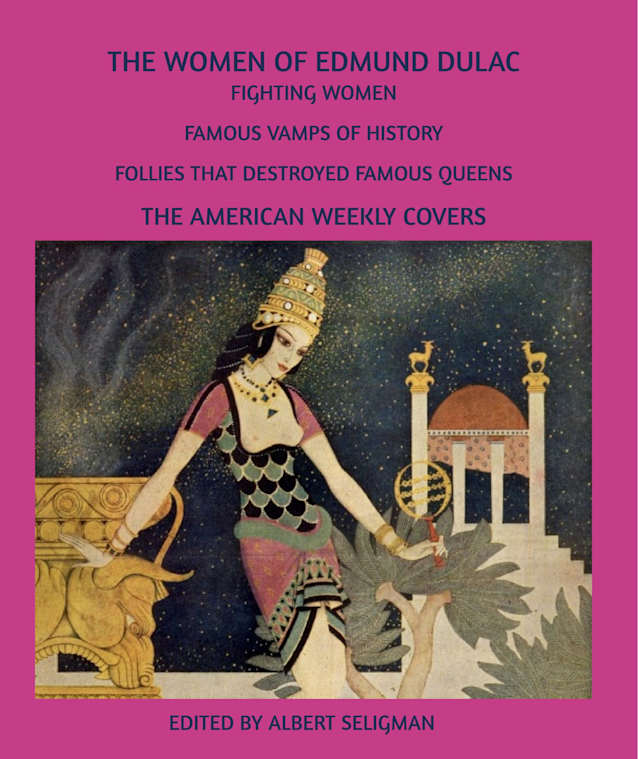
THE WOMEN OF EDMUND DULAC
About
In 1923, “Edmund Dulac, the Distinguished English Artist,”as he was billed on the front covers, was contracted by the Hearst organization to paint watercolors for The American Weekly. The contract lasted nearly 30 years.From the 1920’s onward, Dulac’s income came primarily from his American Weekly work. . Dulac painted 106 watercolors from 1924-1951 for thirteen different series for The American Weekly, until his final ‘Tales from the Arabian Nights’ in 1951.
The three series featured here are
- “Famous Vamps of History” from 1929
- “Follies That Destroyed Famous Queens” from 1934
- “Fighting Women” from 1938.
The Vamps series was the first to print clearly, as the Hearst Corporation changed to a better-quality newsprint and reduced the size of the tabloid. This allowed Dulac to paint the image larger, so that by reducing, it gained sharpness. Queens was an overlapping theme, and Semiramis starred in both. Fighting Women was more of an action animated series, with several women in battle, mostly against men foes. Sadly, few triumphed in the end.
Famous “Vamps” of History 1929
- The Queen of Sheba
- Circe the Sorceress
- Salome of Old Jerusalem
- Atalanta and the Golden Apple
- Yang Kuei Fei--The Chinese Cleopatra
- Ariadne
- Semiramis
- Helen of Troy
Follies That Destroyed Famous Queens 1934
- Semiramis
- Dido
- Cleopatra
- Isabella of Bavaria
- Queen Chand
- Marie Antoinette
- Mary Queen of Scots
Fighting Women 1938
- Penthesilea
- Hippolyte and Hercules
- Thomyris
- Zenobia
- Joan of Arc
- Mu-Lan
- Molly Pitcher
Trailer
Praise for this book
In yet another labor of love from Albert Seligman, we have a new collection of artist Edmund Dulac’s illustrations, which once graced the covers of The American Weekly Sunday newspaper supplements. If you’re unfamiliar with that publication, this book begins with an overview of The American Weekly and its featured artwork.
For eight weeks in early 1929 the magazine featured a “Famous “Vamps” of History” theme. Mid-year 1934 brought seven illustrations of “Follies That Destroyed Famous Queens”, and the summer of 1938 gave us seven “Fighting Women”.
While these certainly weren’t the first themed series in the magazine, they were the first to be printed on a higher quality of newsprint than had previously been used. Also, a change in the magazine’s size coupled with Dulac’s now larger-sized artwork had the happy side effect of sharpening the images. Considering the flimsy nature of newsprint, any improvement is welcome.
I happily added this collection to my collection of Dulac collections. 🙂 Immersing in high quality, richly colored, fantastical illustrations is a wonderful way to escape everyday life for a short time. I love studying the smallest of details; the tapestry and clothing patterns, delicate fingers and toes, jewelry I wish I owned. I especially enjoy interpreting the emotions expressed on the character’s faces. I’m a big fan of ‘Dulac eyes’. For example, Thomyris expression as she gazes on the severed head of Cyrus. And can you imagine how Septima Zenobia, the Queen of Palmyra, is feeling as she realizes she’s about to be captured and tortured? In the same scene, you can see the shock and fear in her son’s expression. Every character that flows from Edmund Dulac’s brush tells a story through body language and facial expressions. No two are alike, and their emotions run the gamut. It’s fascinating and compelling stuff. (And I can’t wait for you to see Molly Pitcher!)
If this is your introduction to Albert Seligman’s series of The American Weekly collections, you’re in for a visual treat. If you’ve been with this project since the beginning, you’re no doubt anxious to dive in once again.