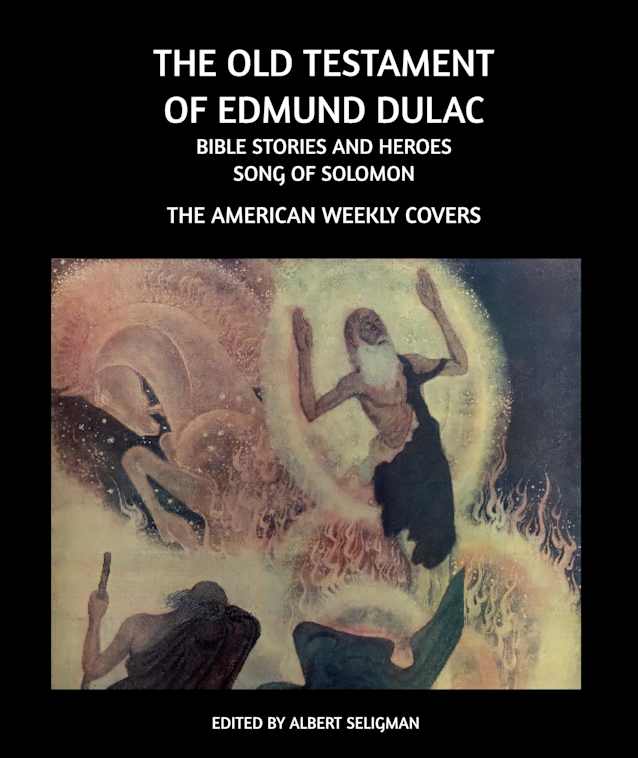
The Old Testament of Edmund Dulac-Bible Scenes and Heroes and Song of Solomon: The American Weekly Illustrations (EDMUND DULAC’S AMERICAN WEEKLY ILLUSTRATIONS)
About
In 1923 Edmund Dulac received an offer from the Hearst Corporation to paint the front covers for the Sunday supplement of the New York Weekly American. Colin White writes in his biography Edmund Dulac (Studio Vista 1976) “Each series was to consist of eight to twelve consecutive issues on a theme suggested by Dulac, but subject to editorial approval. The first group, Bible Scenes and Heroes, a title which was considered a suitable introduction to Sunday reading for the family, was to be ready for the following autumn.”
“The first series, described as being by, ‘The Distinguished English artist Edmund Dulac’, appeared on 5 October 1924 with a well heralded but inauspicious opening titled The Angel with the Fiery[sic.] Sword drives Adam and Eve out of Eden which was redeemed only by the magnificent sword in the angel’s hand. There was some excuse for the weakness of this opening picture. Dulac had originally intended portraying The Birth of Eve, but his watercolor, which showed both Adam and Eve without navels, was considered controversial.”
In 1930 Dulac started drawings for The Book of Revelations which he wanted to include as a series. He completed The Four Horseman of the Apocalypse and The Scarlet Woman of Babylon both in a rather morbid style for which he was unaccustomed. The series’ were never completed and his next Bible themed stories was the lovely 1936 Song of Solomon.
Bible Scenes and Heroes had no text accompanying the illustrations. The Song of Solomon was accompanied by the Bible verse it illustrated.
White comments (p.170) “Dulac’s continued serenity showed itself in The Song of Solomon on which he was working for The American Weekly. In each of the watercolors he was able to recreate some of the wistfulness of his Birth of Eve, especially in I am black but comely, where he conveyed the sad, distant look on the maiden’s face and the sympathy in the slave girl’s eyes with their eyebrows again painted to meet in the midline. The colours were bold but simple, and the drawing so sensitive that one can detect a complete rapport with the sentiments expressed.”
The two series in this volume are-
BIBLE SCENES AND HEROES 1924
The Angel with the Flaming Sword drives Adam and Eve out of Eden
Lot’s Wife Looks Back Upon the Cities of the Plains and is Turned into a Pillar of Salt
The Infant Moses is found in the Bulrushes by Pharaoh’s Daughter
The Walls of Jericho Fall Under the Blast of Joshua’s Horn
Samson Pulls down upon Himself and the Idolaters the Walls of Their Temple
Ruth Uncovers the Feet of Boaz
King Saul and the Witch of Endor
David and Goliath
The Judgment of Solomon
Elijah and the Chariot of Fire
Queen Esther and Haman
THE SONG OF SOLOMON 1936
“If Thou Know not, O thy fairest Among Women”
“My Beloved is Like a Roe or Young Hart”
“It was but a little that I passed from them”
“Awake O north wind”
“I sleep but my heart waketh”
“Whither is thy beloved gone?”
“How beautiful are thy feet with shoes”
“We have a little sister”
Praise for this book
If you’ve enjoyed Albert Seligman’s previous collections, you already know what a treat this book will be. If you haven’t read one before, I’m confident you will enjoy this book. While it’s shorter than most of the others, it packs an information-punch while still focusing on the art. Even with less narrative or storytelling, it’s more educational than you might expect.
There’s a handful of paintings that are displayed twice, in a “compare and contrast” exercise. For example, I was admiring the composition and cheery facial expressions in The Infant Moses is found in the Bulrushes by Pharaoh’s Daughter, and on the following page I was presented with another version of the same piece. That version had been reproduced in 1926, using higher quality ink and paper. It was dramatically better.
There are surprises around every corner in this collection. The Scarlet Woman of Babylon is recognizable as a Dulac, with his weirdly whimsical, almost oriental monster faces, and a classic Dulac woman’s figure, notably the separated small breasts. But I was surprised by the lack of color. It’s all done in ivory and grey tones. In fact, it’s such a departure from what one might expect of Dulac that it’s no surprise to learn that The American Weekly rejected it.
Another surprise was Dulac’s decision to use Cubism in The Walls of Jericho Fall Under the Blast of Joshua’s Horn The tumbling walls scatter about like a child’s Legos. It’s an impressive way to convey the destructive event.
In Ruth Uncovers the Feet of Boaz, I couldn’t help wondering if the nearly-skeletal withered arm of Ruth is a victim of faulty printing. In contrast, her face is intensely realistic, actually more realistic than any other element in the painting. I’d like to learn more about why this is.
We are shown two versions of King Saul and the Witch of Endor, and it’s startling to see how much detail was lost in The America Weekly version. I’m grateful for Albert Seligman and his efforts to preserve and, when possible even restore, what we have left of this irreplicable artwork.
The final piece is an original study drawing of a clothed woman, giving us a glimpse into Dulac’s creative process.
I’ve only touched on a few examples of the artwork in this collection. You have so much more to discover once you’ve added this volume to your personal library.