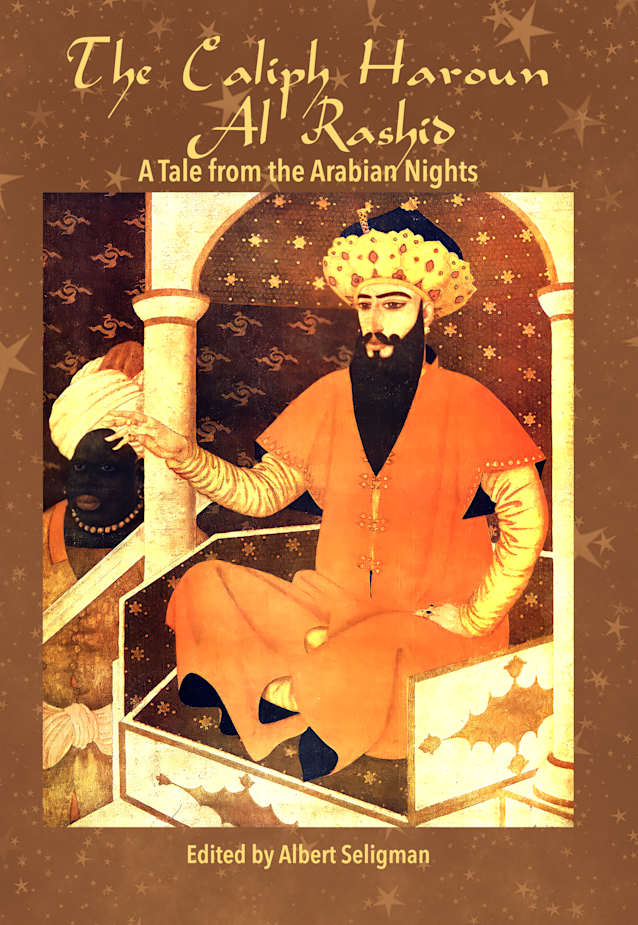
The Caliph Haroun Al Raschid
About
These tales from the Arabian Nights are the adventures of Caliph Haroun Al Raschid, the Defender of the Faithful, and his travels among his followers in Bagdad. He would often disguise himself and walk among his people, so as to learn their habits and problems. These Tales are some of his adventures, and are the best well known and, fortunately for us, the best illustrated. The edition contains over 100 line drawings, engravings and full color watercolors to enjoy as you read the stories of-
- THE THREE CALENDERS, SONS OF KINGS, AND FIVE LADIES OF BAGDAD
- THE HISTORY OF THE FIRST CALENDER
- THE HISTORY OF THE SECOND CALENDER
- THE HISTORY OF THE ENVIOUS MAN, AND OF HIM WHO WAS ENVIED
- THE HISTORY OF THE THIRD CALENDER (PRINCE AGIB)
- THE STORY OF ZOBEIDE
- THE HISTORY OF ANIMA
Our stories begin one day with a simple porter who is hired by a beautiful lady to carry many packages for a party later in the evening. When they reach the ladies’ home, the porter is invited to remain for a refreshment with the lady and her two sisters, also great beauties. Suddenly, a knock on the door finds three young calenders, all with their heads and beards shaved, asking for shelter for the night. They are all newly arrived in Bagdad, and know not where to lodge. Each is also blinded in the right eye. The ladies kindly invite them to join in the merriment. The calenders offer to play a song for their hosts, and as they finish another loud knock on the door interrupts the festivities. Three merchants appear, and claiming they were locked out of their lodging, also seek shelter. They are no merchants, unknown to the party, but the Caliph himself, with his Vizier and Chief of Household.
They too are invited to join, and advised to mind their own affairs, and ask no questions about anything they see or hear during their visit. They comply, but when Zobeide, the first lady, brings two black dogs before the party and whips each of them with 100 lashes, their curiosity overtakes their sense, and beg to inquire of how this came to be.
Breaking their promise is not taken lightly by Zobeide, who claps her hands to summon seven slaves all holding scimitars to the throats of the guests. Before executing them, she decides to interrogate them first, to discover their identities. Each in turn tells his story, and is permitted to sit and listen to the next speaker.
The three calenders are all princes, sons of kings, and their tales of betrayal, battle, enchantment and fantasy will hold you spellbound. They depart, but the next day the Caliph brings them all before him to hear the stories of the sisters. Again, the tales of stone cities, flying serpents, witchcraft and betrayal will delight the reader.
The artists and illustrators included in this edition were active from 1800 through 1930. Some of the oldest illustrations are woodcuts or metal engraving plates, many made by the famous Dalziel Brothers. The twentieth century artwork is photographic reproduction, all in full color. The artists in this edition include- Edmund Dulac, Virginia Frances Sterrett, Milo Winter, Maxfield Parrish, Thomas Dalziel, John Dixon Batten, Edwin Arthur Norbury, William Heath Robinson, Stanley Llewellyn Wood, Henry Justice Ford, Arthur Boyd Houghton, Frederick Gross, Robert Smirke, Frances Brundage, Edmund Julius Detmold, René Bull, John Everett Millais, Joseph Benwell Clark and Ebenezer Landells.
We hope you enjoy this edition and collect the whole series.
Trailer
Praise for this book
This book is one of six in a series that brings you tales of the Arabian Nights. Each book contains a specific group of the tales. Here you’ll find the adventures of Caliph Haroun Al Raschid.
What sets this series apart from other versions of these classic stories, besides Edward Lane’s excellent translations, is the artwork. Literally every page is graced with stunning scenes created by artists from the Golden Age of Illustration (late 1800s-early 1930s). Over 100 watercolors, black and white line drawings, and engravings are waiting to dazzle your eyes. Editor Albert Seligman has taken the time to ensure that the artwork’s colors are the best they can possibly be.
If you are new to the tales of the Arabian Nights, jump in! This book and its companion volumes are a fine place to start. Those who appreciate the artwork of the Golden Age of Illustration are going to want the entire series, both for reference and pure enjoyment.