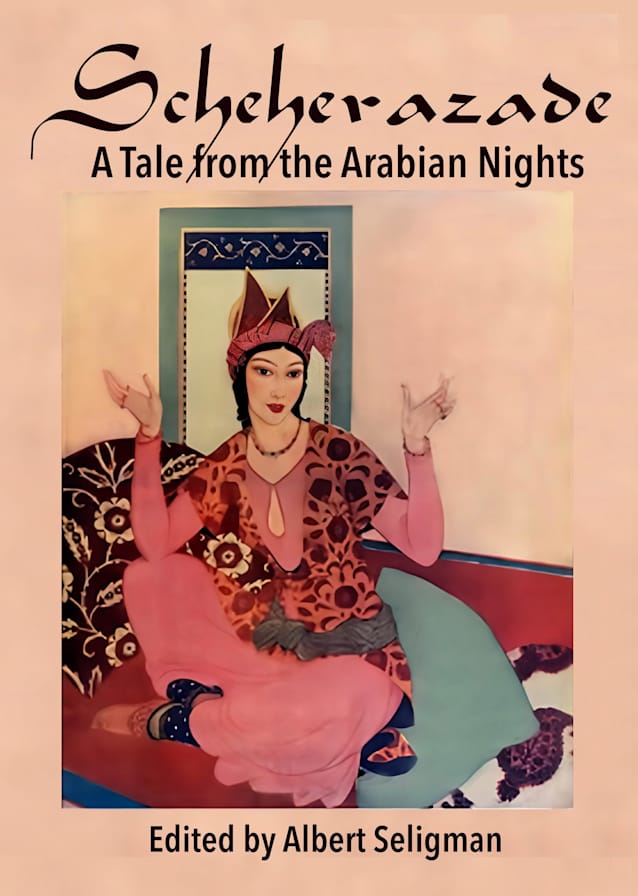
SCHEHERAZADE- A TALE FROM THE ARABIAN NIGHTS
About
“No one knows where the tales were written, except that they came out of the Far East, India, Arabia and Persia. Haroun Al Raschid, who was called The Just, was a real Eastern monarch who lived in Baghdad over eleven hundred years ago, about the same time that Charlemagne was King of France. We can believe that the tales are very old, but the most we know is that they were translated from Arabic into French in 1704-17 by a Frenchman named Galland, and that the manuscript of his translation is preserved in the French National Library. American boys first had the chance to read the notes in English about the time President Monroe was elected.” (1817) (The Junior Classics, Volume 5: Stories that never grow old, Editor William Patten, 1912).
SCHEHERAZADE A TALE FROM THE ARABIAN NIGHTS
Dulacebooks’ new Arabian Nights series presents these tales decorated with the illustrations from the original editions of the Victorian and Golden Age. Over fifty different illustrators’ versions of these stories are reproduced here, fully restored and many in full color. These are the finest examples of the artists and illustrators of the Arabian Nights, including-
Arthur Rackham, Edmund Dulac, Kay Nielsen, René Bull , Maxfield Parrish, William H Robinson, Thomas H Robinson, Charles Robinson, Thomas Mackenzie, Walter Crane, Louis Rhead, Helen Stratton, Virginia Frances Sterrett, Elizabeth Mackinstry, John Gilbert, HJ Ford, Edward J Detmold, Eric Pape, AE Jackson, Willy Pogany, Milo Winter, Monroe S Orr, Charles Folkard, Walter Paget, William Stang, JD Batten, Frances Brundage, Gustav Dore, FOC Darley, William Harvey, the Brothers Dalziel, and many others.
The first book in the series is how the 1001 nights begin, with Scheherazade and her sister weaving the tales to her new husband Schahriar, the Sultan. The Tales in this edition are:
The Sultan and his Vow
The Fable of the Ass, the Ox, and the Laborer
The Story of the Merchant and the Genie
The History of the First Old Man and the Hind
The History of the Second Old Man and the two Black Dogs
Trailer
Praise for this book
I’ll start with the book cover. There’s a beautiful depiction of Scheherazade, created by Edmund Dulac in 1925 for The American Weekly magazine. This legendary storyteller is portrayed as sitting on plump pillows in a room devoid of wall decor. Her head is framed within a doorway, a clever way to make her the center of attention. Everything about this painting focuses the viewer’s eyes on the woman. I like this selection of cover art for its subtle message and soothing use of colors. I’ve left it lying out on my desk rather than shelving it simply because occasionally glancing over at that cover makes me smile.
Once I was finally able to look away from the cover, I found the interior of the book to be quite engrossing. I intended to read a few pages and then set it aside, but somehow I forgot to stop, and read the entire book. I can always use a good lesson in art history and came away feeling more educated. Even the preface was chock-full of useful background information that helped set the stage for the stories and illustrations to come.
Five of Scheherazade’s tales are told in easy to understand, clear language. The stories are generously surrounded by the works of over fifty (yes fifty!) illustrators. The artwork has been fully restored, and quite a bit of it is in vibrant, full color.
These are stories that benefit from that lavish display of art, as the images really do bring the stories to life. While this book was not created specifically for young people, I believe that students who are learning to love classic literature will get a lot out of it. It’s a book that will appeal to many people with a variety of interests.
I’m happy to have this beautiful book on my shelves, er, well, desktop. I just can’t put it away quite yet. Ask yourself if you are in need of some eye candy, and after you admit that you are, grab a copy for your own desk or tabletop. No shelving required.