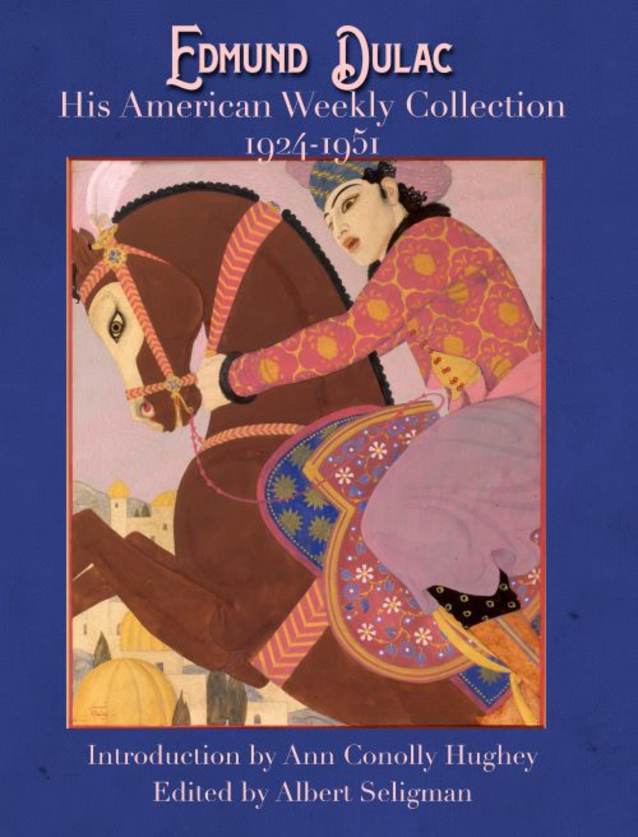
EDMUND DULAC HIS AMERICAN WEEKLY COLLECTION 1924-1951
About
In 1923, “Edmund Dulac, the Distinguished English Artist, "as he was billed on the front covers, was contracted by the Hearst organization to paint watercolors for The American Weekly magazine, the Sunday supplement for the newspapers. The contract lasted nearly 30 years. Dulac painted 106 watercolors from 1924-1951 for thirteen different series for The American Weekly. This is Dulac’s largest body of work, and has never before been assembled or published.
This collection includes all full color illustrations used for the front covers and several that were never published. All the images have been restored and printed with high quality inks. The introduction was written by Ann Hughey.
Ann Conolly Hughey was Dulac's bibliographer, and published her edition of his nearly 100 books (Buttonwood Press, 1995). She wrote his history of publishing in America for the introduction of this edition. She was also a collector of Dulac's books, paintings, drawings, stamps and correspondence, and has one of the most complete collections in the world. The American Weekly covers were often cited in her bibliography, and many were featured in full-color in the "Edmund Dulac" biography of Colin White. ( Studio Vista,1976)
This edition compliments their works and will be a welcome addition to Dulac collections.
The American Weekly Covers 1924-1951
1924.....Bible Scenes and Heroes
1925.....Characters From the Arabian Nights
1929.....Famous Vamps of History
1931.....Love Stories the Ancients Believed In
1932.....Enchanting Fairyland Lovers
1933.....Myths the Ancients Believed
1934.....Follies that Destroyed Famous Queens
1936.....Song of Solomon
1937.....Beauty and the Beast
1938.....Fighting Women
1940.....7 Tales From King Arthur's Court
1942.....8 Canterbury Tales
1951.....Tales from The Arabian Nights
Praise for this book
A wonderful tribute to Dulac’s work. The images are beautiful, vibrant, and very high-quality, and they pair perfectly with these timeless stories. Albert Seligman did a fantastic job assembling and restoring this body of art from the Golden Age of Illustration. Highly recommended!
In 1923, Edmund Dulac, the distinguished English artist, was contracted by the Hearst organization to paint watercolors for The American Weekly magazine, the Sunday supplement for the newspapers. The contract lasted nearly 30 years. Dulac painted 106 watercolors from 1924-1951 for thirteen different series in The American Weekly. This is Dulac's largest body of work, and has never before been assembled — and it's some of his finest work! This includes all full color illustrations used for the front covers and several that were never published. All the images have been restored and printed with high quality inks. The introduction was written by Dulac bibliographer Ann Hughey.
I have just received Albert Seligman’s book, Edmund Dulac, His American Weekly Collection 1924-1951. As a long-term admirer of Dulac, I thoroughly enjoyed this book that is handsomely presented in a hardbound format with illustrations on almost every page, all in full color. The quality of the 106 watercolors that Dulac drew for the American Weekly, as reproduced in Seligman’s book, is excellent and the extended descriptions of the legends behind the illustrations are an added bonus. This book presents a well-written account of an aspect of Dulac’s artwork not known to many collectors. It contains contributions by the world’s two foremost experts on the life and work of Dulac, Colin White and Ann Hughey and the author has dedicated his book to them. Every admirer of Edmund Dulac and the art of illustration will be pleased to add Albert Seligman’s book to their libraries.
Edmund Dulac's reputation rests on his luxurious gift book illustrations from the Edwardian era—those jewel-toned renderings of Sinbad, the Snow Queen, and Shakespeare's heroines that established him alongside Arthur Rackham and Kay Nielsen in the pantheon of Golden Age illustrators. What most admirers don't realize is that Dulac's largest sustained body of work appeared not in leather-bound volumes for discriminating collectors, but in The American Weekly, the Sunday supplement that landed on millions of doorsteps alongside the funny pages.
This remarkable volume finally assembles that hidden chapter of Dulac's career. From 1924 to 1951, under contract to the Hearst organization, Dulac produced 106 watercolors across 13 different series for the magazine. The work has remained scattered and largely forgotten, overshadowed by his earlier book illustration triumphs. Albert Seligman and Ann Conolly Hughey have performed a genuine service to illustration scholarship by tracking down and restoring these images.
The results challenge assumptions about commercial assignment work. Dulac brought the same meticulous craftsmanship to these magazine commissions that distinguished his deluxe editions. The watercolors reproduced here—all the front covers plus several unpublished pieces—demonstrate an artist working at full capacity despite the ephemeral nature of the venue. His characteristic palette, that distinctive combination of deep blues, burnished golds, and subtle earth tones, translates beautifully to high-quality printing.
Hughey, established as the foremost Dulac bibliographer, provides an introduction situating this work within the artist's broader career. The nearly three-decade span of the commission allows readers to track stylistic evolution while observing how Dulac adapted his aesthetic to American popular tastes without compromising his essential vision.
The restoration work deserves particular praise. Sunday supplements were printed on cheap newsprint; survival copies tend toward the yellowed and foxed. The images here have been cleaned and color-corrected to approximate their original appearance, then printed with archival inks that do justice to Dulac's subtle tonal gradations.
For Dulac collectors, this fills a significant gap. For students of American magazine illustration, it documents an unexpected intersection of European fine art sensibility and mass-market publishing. For anyone who appreciates watercolor mastery, it's simply a pleasure to look at. The book stands as essential reading for anyone serious about the history of 20th-century illustration on both sides of the Atlantic. One hopes this publication sparks renewed interest in Dulac's later career, which deserves far more attention than it has received. A triumph of research and bookmaking.