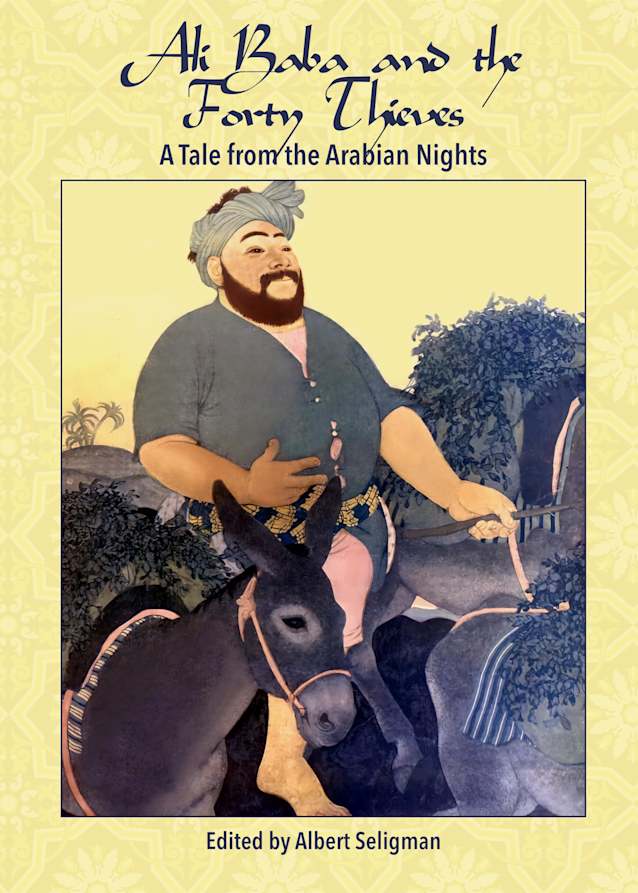
Ali Baba and the Forty Thieves (Illustrated)
About
This edition is fully illustrated with over 60 color and line drawings
- Full-color illustrations by Edmund Dulac, René Bull, Maxfield Parrish, VF Sterrett, Helen Stratton, MS Orr, Walter Crane, WH Robinson and others
- Line drawings by the finest Victorian and Edwardian illustrators, including Eric Pape, Walter Strang, JC Clark, T Dalziel, Louis Rhead, HG Fell, Alessandro Castelli and others
- One illustration on every page
- Full bibliography of all illustrated editions from 1800-1950, including artist, date and publisher
The Arabian Nights tale of ‘Ali Baba and the Forty Thieves’ is among the most popular and frequently retold. The original manuscript doesn’t seem to have been one of those first translated into French by Antoine Galland, and may be one he wrote himself.
The story is about two brothers whose father died and left them little. Ali Baba married a poor woman and lived frugally, but Cassim married a woman who soon inherited a fortune and lived in luxury. One day while Ali Baba was in the forest cutting wood to sell he saw a great cloud of dust approaching and the sound of many riders. He feared for his life, so he hid his three donkeys and hid himself in a tree. The band of forty riders and their leader stopped in front of a cave. When the leader said “ Open Sesame” the door of the cave magically opened. The whole troop went inside while Ali Baba stayed hidden. When he was sure they had gone, he approached the cave door and said “ Open Sesame” himself as the cave door magically opened to his command. Inside the cave he saw vast riches and golden coins, which he liberally took for himself and returned home with his donkeys, remembering to properly close the cave door with the “Shut Sesame “ command.
His wife was astonished at all the gold coins he brought home and wanted to count them before Ali buried them in his yard. As there were too many to count, she borrowed a measuring cup from her sister-in-law. She was curious as to what they might have to measure something, so she cleverly put some suet on the bottom to see what would stick. After the cup was returned with a gold coin stuck to the bottom, she called her husband Cassim to tell him what happened.
Cassim went to Ali’s house and demanded to know how he got a gold coin, and Ali told him everything, including the magic password. Cassim was very greedy, so the next day he set out with many donkeys to find the cave and removed as much treasure for himself as possible. In his haste, he forgot the magic words to open the cave and was trapped inside when the robbers returned. They killed him and cut his body in pieces.
When Cassim didn’t return, Ali feared the worst and returned to the cave to find him. He found his brother’s body and returned to town. He knew the robbers would find out if anyone had been murdered in such a fashion, so they sewed Cassim’s body back together and pretended he died a natural death.
The robbers sent scouts to town to determine if anyone had died and discovered Ali Baba’s house. The captain of the robbers disguised himself as an oil merchant and hid his band in leather jars planning to murder all the household. When Morgiana, Ali Baba’s clever slave girl discovers the ruse, she murders all the robbers. The captain flees, but soon returns in another disguise to take his revenge. Again she discovers him, plunges a dagger into his heart and saves her master.
If you enjoy this tale, I’m sure you will enjoy the whole series on Amazon. The other titles include-
- Scheherazade
- The Enchanted Horse
- The Caliph Haroun al Rashid
- Aladdin and the Wonderful Lamp
- The Seven Voyages of Sindbad the Sailor
Trailer
Praise for this book
This book is one of six in a series that brings you tales of the Arabian Knights. Each book contains a specific group of the tales. Here you’ll find the adventures of Caliph Haroun Al Raschid.
What sets this series apart from other versions of these classic stories, besides Edward Lane’s excellent translations, is the artwork. Literally every page is graced with stunning scenes created by artists from the Golden Age of Illustration (late 1800s-early 1930s). Over 100 watercolors, black and white line drawings, and engravings are waiting to dazzle your eyes. Editor Albert Seligman has taken the time to ensure that the artwork’s colors are the best they can possibly be.
If you are new to the tales of the Arabian Knights, jump in! This book and its companion volumes are a fine place to start. Those who appreciate the artwork of the Golden Age of Illustration are going to want the entire series, both for reference and pure enjoyment.
My personal favorite illustration is on page 63, done by Maxfield Parrish in 1909. The scene is deceptively simple at first; a man walks down a long staircase with massive pillars at the top. The scene is dappled with playful shadows and light in some places, while deeper shadows literally swallow everything they touch in darkness. You can feel the shift in air temperature, I swear you can almost smell the stonework cooling in the shade. (Stonework has a scent. I know this from experience.)
There are so many illustrations just waiting to draw you in, as they bring to life to outlandish stories from long ago. This is truly a book to read repeatedly, and treasure.