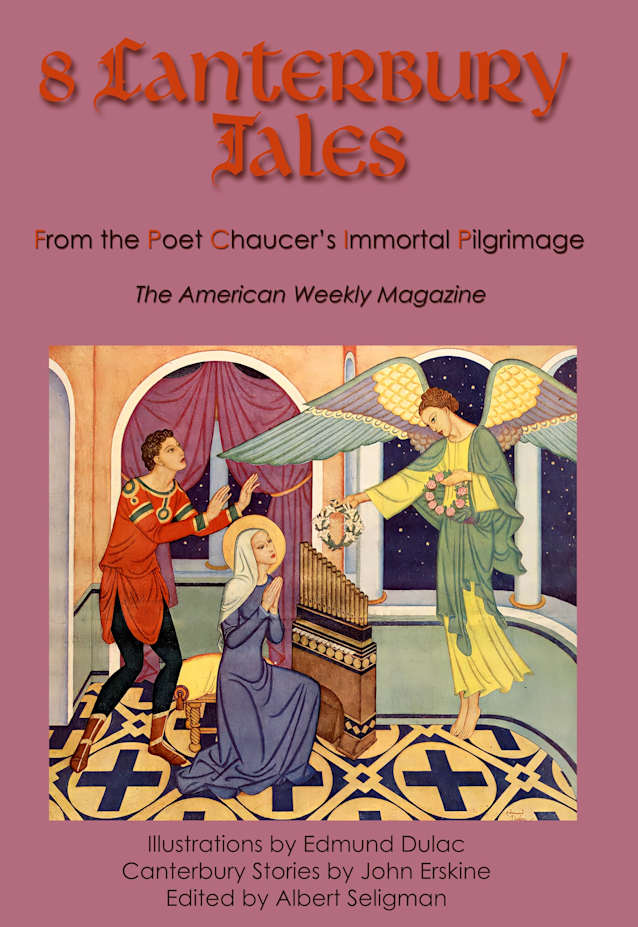
8 CANTERBURY TALES: FROM THE POET CHAUCER’S IMMORTAL PILGRIMAGE
About
What the Canterbury Tales Are
The Canterbury Tales are one of the great classics of all literature. They were written by Geoffrey Chaucer, poet, warrior, diplomat and royal pensioner, about 1387, and are famous for the pictures they give of life in the 14th century. The tales were supposed to have been told by various members of a pilgrimage to Canterbury Cathedral in England to while away the time. John Erskine, celebrated author of The Private Life of Helen of Troy, now relates these tales delightfully for the readers of The American Weekly, and Edmund Dulac, famed English painter and etcher, makes them vivid with his incomparable art.
These eight illustrations were published in The American Weekly magazine in 1942. John Erskine provided his interpretation of the Tales and his essay about the Canterbury Tales from his 1928 The Delight of Great Books is included with additional illustrations. There is a further reading section which also includes illustrated editions from the early nineteenth century to the present.
Other illustrators featured in this edition include-
Burne Jones from the Kelmscott Chaucer, W.H. Robinson, Maria L Kirk, Willy Pogany, Hugh Thomson, Rudolf Belarski, Mrs. H.R. Haweis, Anne Anderson, W. A. Clark, Warwick Goble, Milo Winter, Thomas Bewick, Edward Courbold, Edith Ewen, Mabel Peacock, W.R. Flint, Arthur Szyk and Gustav Tenggren.
The 8 Canterbury Tales included are-
The Student’s Tale of Patient Griselda
The Knight’s Tale of Emily’s Lovers
The Miller’s Tale of the Carpenter’s Wife
The Squire’s Tale of Canace and the Talking Falcon
The Wife of Bath’s Tale of the Amorous Knight
The Merchant’s Tale of the Doting Husband
The Man of Law’s Tale of What Happened to Constance
The Second Nun’s Tale of Saint Cecilia
All the original artwork for the covers has been restored, and a crop of each image follows the tales. This was a difficult undertaking for Dulac, who moved out of London due to the bombing during the war. The illustrations had to be sent by ship to America, and avoid Axis warships and submarines looking to sink any Allied vessel.
Dulac never before tried to illustrate either King Arthur, his 1940 American Weekly series, or Canterbury Tales, unlike many of his famous contemporaries. I would speculate that Hearst approved these two series to rally the Americans to help the English during their hour of need by showcasing two of their most well known and liked classics.
Trailer
Praise for this book
The classics are for everyone.
I enjoyed the author’s commentary on Chaucer’s work in both the introduction as well as sprinkled through the later sections. It felt like sitting in a university literature class and hearing what the professor thought of these famous stories. Sometimes he had sharp takes on certain characters or themes, and his strong opinions about them echoed in my mind as I read them for myself. There is definitely something to be said for knowing in advance what you’re getting into before diving into this collection.
I was surprised to learn how often these stories have been marketed to kids and teenagers over the years. Some sections showed rare pages from vintage youth-friendly magazines that printed them with gorgeous illustrations of the most important scenes. This wasn’t something I was expecting to find, but it made me read the sometimes-violent passages in a new light as I imagined what sorts of lessons young readers might be expected to learn from them. This is one of many reasons why I’m always excited to see new submissions from Mr. Seligman as he has consistently taught me all sorts of things about literature, art, and history that I was not previously aware of.
One of the things I liked the most about the Canterbury tales themselves were the glimpses they shared with the reader about medieval life. Yes, human nature has remained the same, but many social conventions and cultural expectations of how someone should behave have not. This was especially interesting when it came to things like explaining why some people were poor or why certain sexes or social classes were expected to behave in different ways than others were.
8 Canterbury Tales was a well-rounded introduction to these famous stories.